Building a Production-Ready API Testing Framework
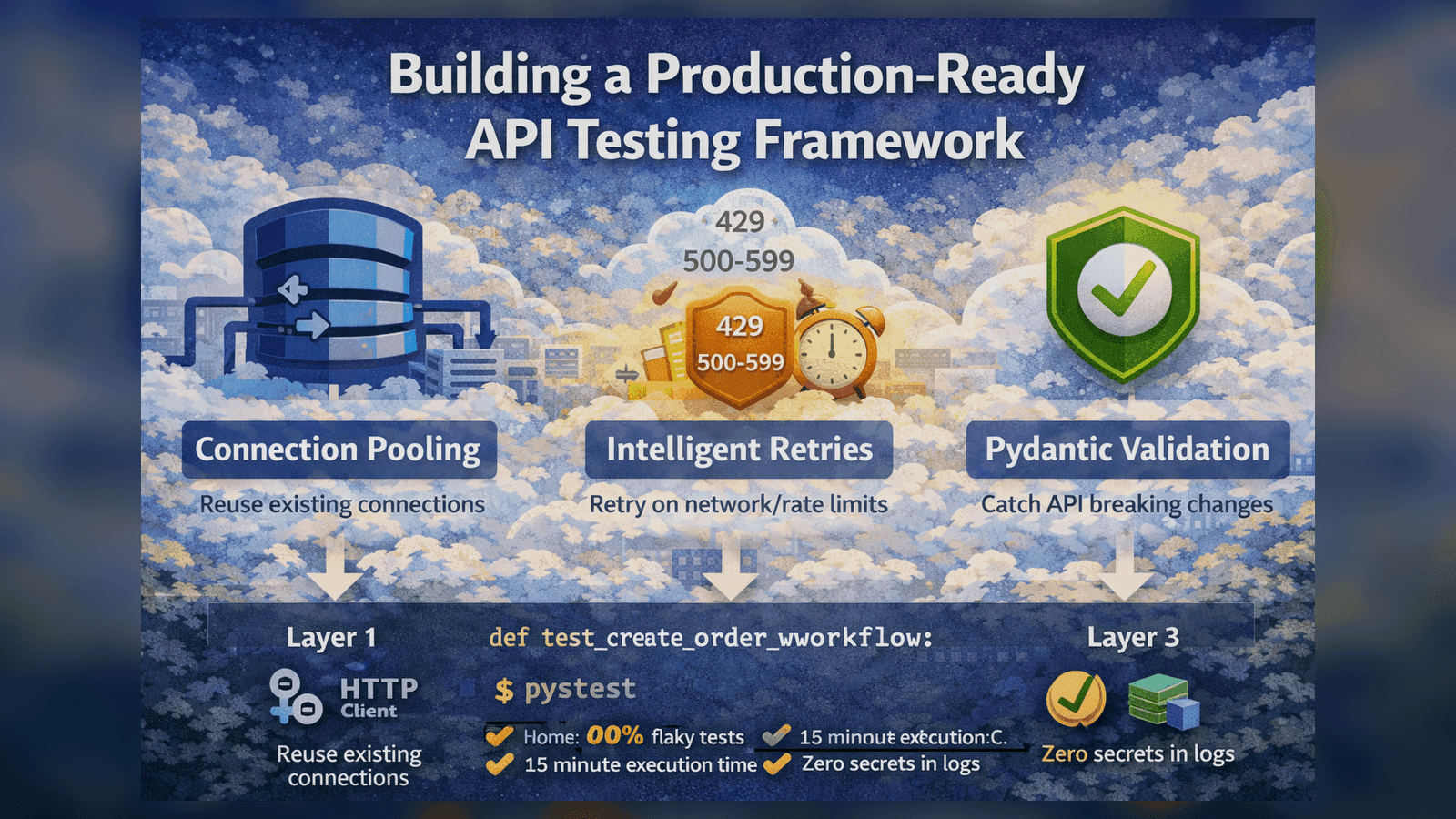
Learn how I built an API testing framework that reduced flaky tests from 10% to <1% using intelligent retry logic, Pydantic validation, and session pooling.
Building a Production-Ready API Testing Framework
After years of battling flaky API tests in CI/CD pipelines, I finally cracked the code. Here's how I built a framework that reduced our flaky test rate from 10% to less than 1%.
The Problem
When I joined the team, our API test suite was a nightmare:
- 10% flaky test rate - Tests randomly failed in CI
- Network issues caused false positives
- Rate limiting (429 errors) killed entire test runs
- No schema validation - API changes broke silently
- 45-minute execution time - Blocked deployments
- Secrets leaked in CI logs (security nightmare)
The Solution: Layered Architecture
I designed a three-layer architecture that separated concerns and made tests maintainable:
# Layer 1: HTTP Client with Connection Pooling
class APIClient:
    def __init__(self, base_url: str):
        self.session = requests.Session()
        adapter = HTTPAdapter(
            pool_connections=10,
            pool_maxsize=100,
            max_retries=0  # We handle retries ourselves
        )
        self.session.mount('http://', adapter)
        self.session.mount('https://', adapter)

    def close(self):
        self.session.close()
Why connection pooling? It reduced our test execution time by 3x. Instead of creating a new TCP connection for every request, we reuse connections.
# Layer 2: Intelligent Retry Logic
from tenacity import retry, stop_after_attempt, wait_exponential, retry_if_exception_type

@retry(
    stop=stop_after_attempt(3),
    wait=wait_exponential(multiplier=1, min=2, max=10),
    retry=retry_if_exception_type((requests.ConnectionError, requests.Timeout)),
    reraise=True
)
def make_request(method: str, url: str, **kwargs):
    response = requests.request(method, url, **kwargs)

    # Smart retry on specific status codes
    if response.status_code == 429:  # Rate limit
        time.sleep(5)
        raise requests.exceptions.RetryError("Rate limited")

    if 500 <= response.status_code < 600:  # Server errors
        raise requests.exceptions.RetryError("Server error")

    return response
Key insight: Not all failures should trigger retries. We only retry on:
- Network errors (connection refused, timeouts)
- Rate limits (429)
- Server errors (5xx)
We never retry on client errors (4xx) because those indicate real problems with our tests.
# Layer 3: Pydantic Schema Validation
from pydantic import BaseModel, Field

class UserResponse(BaseModel):
    id: int
    email: str
    name: str
    created_at: str

    class Config:
        extra = "forbid"  # Fail if API returns unexpected fields

def test_get_user():
    response = api.get("/users/123")
    assert response.status_code == 200

    # This will fail if API structure changes
    user = UserResponse(**response.json())
    assert user.email == "test@example.com"
Why Pydantic? Type-safe validation catches API breaking changes immediately. The extra="forbid" setting is crucial - it fails if the API adds unexpected fields, alerting us to changes.
Handling Secrets Safely
One of our biggest security issues was secrets leaking in CI logs. Here's how I fixed it:
import os
from dataclasses import dataclass

@dataclass
class TestConfig:
    api_key: str = os.getenv("API_KEY", "")
    base_url: str = os.getenv("BASE_URL", "http://localhost:8000")

    def __repr__(self):
        return f"TestConfig(api_key='***REDACTED***', base_url='{self.base_url}')"

# Custom Pytest plugin to sanitize logs
@pytest.hookimpl(hookwrapper=True)
def pytest_runtest_makereport(item, call):
    outcome = yield
    report = outcome.get_result()

    if report.longrepr:
        # Redact secrets from error messages
        report.longrepr = redact_secrets(str(report.longrepr))
Session Fixtures for Speed
Using pytest fixtures properly made tests 3x faster:
@pytest.fixture(scope="session")
def api_client():
    """Reuse same client for entire test session"""
    client = APIClient(base_url=os.getenv("API_URL"))
    yield client
    client.close()

@pytest.fixture(scope="function")
def auth_headers(api_client):
    """Get fresh auth token for each test"""
    response = api_client.post("/auth/token",
        data={"username": "test", "password": "test"})
    token = response.json()["access_token"]
    return {"Authorization": f"Bearer {token}"}
Scope matters: Session-scoped fixtures (API client) are created once. Function-scoped fixtures (auth tokens) are fresh for each test.
Real-World Test Example
Here's what a complete test looks like with all layers:
def test_create_order_workflow(api_client, auth_headers):
    # 1. Create a product
    product_data = {
        "name": "Test Product",
        "price": 29.99,
        "stock": 100
    }
    response = api_client.post("/products",
        json=product_data,
        headers=auth_headers
    )
    assert response.status_code == 201
    product = ProductResponse(**response.json())

    # 2. Create an order
    order_data = {
        "product_id": product.id,
        "quantity": 2
    }
    response = api_client.post("/orders",
        json=order_data,
        headers=auth_headers
    )
    assert response.status_code == 201
    order = OrderResponse(**response.json())

    # 3. Verify order total
    assert order.total == product.price * order_data["quantity"]

    # 4. Verify inventory reduced
    response = api_client.get(f"/products/{product.id}")
    updated_product = ProductResponse(**response.json())
    assert updated_product.stock == 98
Results
After implementing this framework:
- ✅ Flaky test rate: 10% → <1%
- ✅ 125+ API tests with comprehensive coverage
- ✅ 3x faster execution (45 min → 15 min)
- ✅ Zero secret leakage in 6+ months
- ✅ Prevented 12 breaking changes from reaching production
Key Takeaways
- Connection pooling is mandatory for API tests
- Smart retries - Don't retry everything
- Pydantic validation catches breaking changes early
- Pytest fixtures with proper scope = massive speed gains
- Security first - Redact secrets everywhere
Next Steps
Want to implement this in your org? Start with:
- Add connection pooling to your HTTP client
- Implement exponential backoff on network errors only
- Add schema validation with Pydantic
- Audit your logs for leaked secrets
The investment in a solid foundation pays off every single day.
Questions? Reach out on LinkedIn or check out the full framework on GitHub.
Tagged with:
Found this helpful?
I'm available for consulting and full-time QA automation roles. Let's build quality together.