Trayd — AI Companion for the Trades
Built for the people who fix what breaks.
A bilingual AI companion for residential HVAC contractors — estimate builder, diagnostic AI, callback scheduler.
- Role
- Design + build + operate
- Client
- Sage Ideas (Internal)
- Category
- Product
- Status
- Beta Live

Languages
EN + ES
External Capital
$0
Market
Phoenix Metro
Status
Beta Live
Buyer read
What changed here?
Use this as proof for local service businesses that need quote qualification and faster follow-up.
Before
Trades teams lose revenue when quote requests, missed calls, urgency, and scheduling live in separate places.
System
A bilingual lead and quote workflow that captures intent, qualifies jobs, routes urgency, and hands off to the operator.
Result
The team can see who to call, why now, and what the job may be worth before the opportunity cools.
EN + ES
Languages
$0
External Capital
Phoenix Metro
Market
Living architecture
Surface ⇄ System
Trayd is presented as both the product people touch and the operating system underneath it: UI, data model, integration path, evidence, and outcome.
Build an AI product- 01Visible productScreenshots and product frames show the user-facing surface without pretending concept art is production proof.
- 02Operating architectureThe case includes a system map so the architecture is visible, not buried in prose.
- 03Evidence registerMetrics, build logs, diagrams, CI artifacts, and links separate actual work from agency theater.
- 04Commercial pathThe page routes qualified buyers toward a matching build, automation, or lab entry.
// scroll to x-ray the build
surface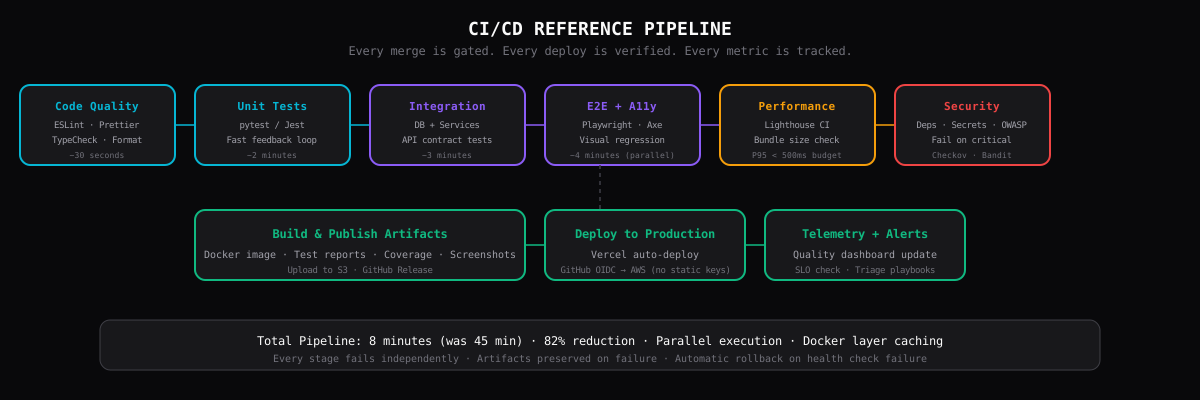 system
case flow
Surface ⇄ System
Trayd operating map
The diagram is intentionally simplified: it shows the buying logic and operating path, not a decorative fantasy architecture.
client
Sage Ideas (Internal)
category
Product
evidence
2 assets
Proof board
Receipts before claims.
This page separates shipped surface, system map, real metrics, and available artifacts so the work can be inspected instead of just admired.
proof assets
4
Screens, gallery, artifacts
screens
2
Real product surfaces
artifacts
0
Available during discovery
Primary evidence
Built for the people who fix what breaks.
Languages
EN + ES
Languages
EN + ES
External Capital
$0
Market
Phoenix Metro
Status
Beta Live
Surface
Product screenshots and interface frames show the user-facing layer. If real assets are unavailable, the page says so instead of dressing mockups as production proof.
System
Architecture diagrams, build logs, and artifacts make the hidden operating layer visible to technical buyers.
Bilingual trades system loop
Surface, system, proof, route.
This storyboard turns the case study into a moving operating map: the buyer sees what was built, where the system lives, and which proof points are actually available.
- languages
- EN + ES
- surface
- mobile-first
- handoff
- operator
What was broken.
The residential trades — HVAC, plumbing, electrical — are a $500B+ industry running largely on clipboards, group texts, and spreadsheets. The software solutions that exist were designed for office workers: complex UI, English-only, cloud-dependent, and priced for enterprise procurement.
The Phoenix metro area alone has thousands of residential HVAC contractors, many of them small owner-operated businesses with bilingual teams. They need tools that work the way they work — fast, offline-capable, bilingual, and built around their actual job: diagnosing systems, writing estimates, booking callbacks.
The specific problems: estimates written in the field get lost before follow-up; crews switch between English and Spanish mid-conversation but tools don't; technicians need diagnostic guidance without slow jobsite connections; callbacks fall through without a lightweight CRM a field tech will actually use.
How it was built.
Bilingual from day one: not a translation layer bolted on later. Every UI element, every AI response, every notification authored in both English and Spanish. Language toggles at the session level — a crew member can switch languages without logging out.
Mobile-first, offline-capable: technicians use phones, not laptops. Every core workflow (estimate creation, diagnostic lookup, callback scheduling) works with degraded connectivity. AI companion, not AI replacement: the AI provides reference documentation, suggests follow-up questions, and drafts estimates based on technician notes.
Stack: Next.js (PWA with service worker for offline), FastAPI backend with Spanish/English prompt templates, Supabase (auth + data with RLS for multi-tenant team accounts), Resend for transactional email, AWS S3 for invoice/estimate PDF storage. Bootstrapped pre-seed with no external capital.
The system map.
How the pieces talk to each other.
Measured, not asserted.
The real figures from the engagement, printed verbatim. Bars are scaled against the largest comparable magnitude in the set — a secondary cue, never the source of truth.
Selected screens.
Real product surfaces from the engagement — not stock illustrations.
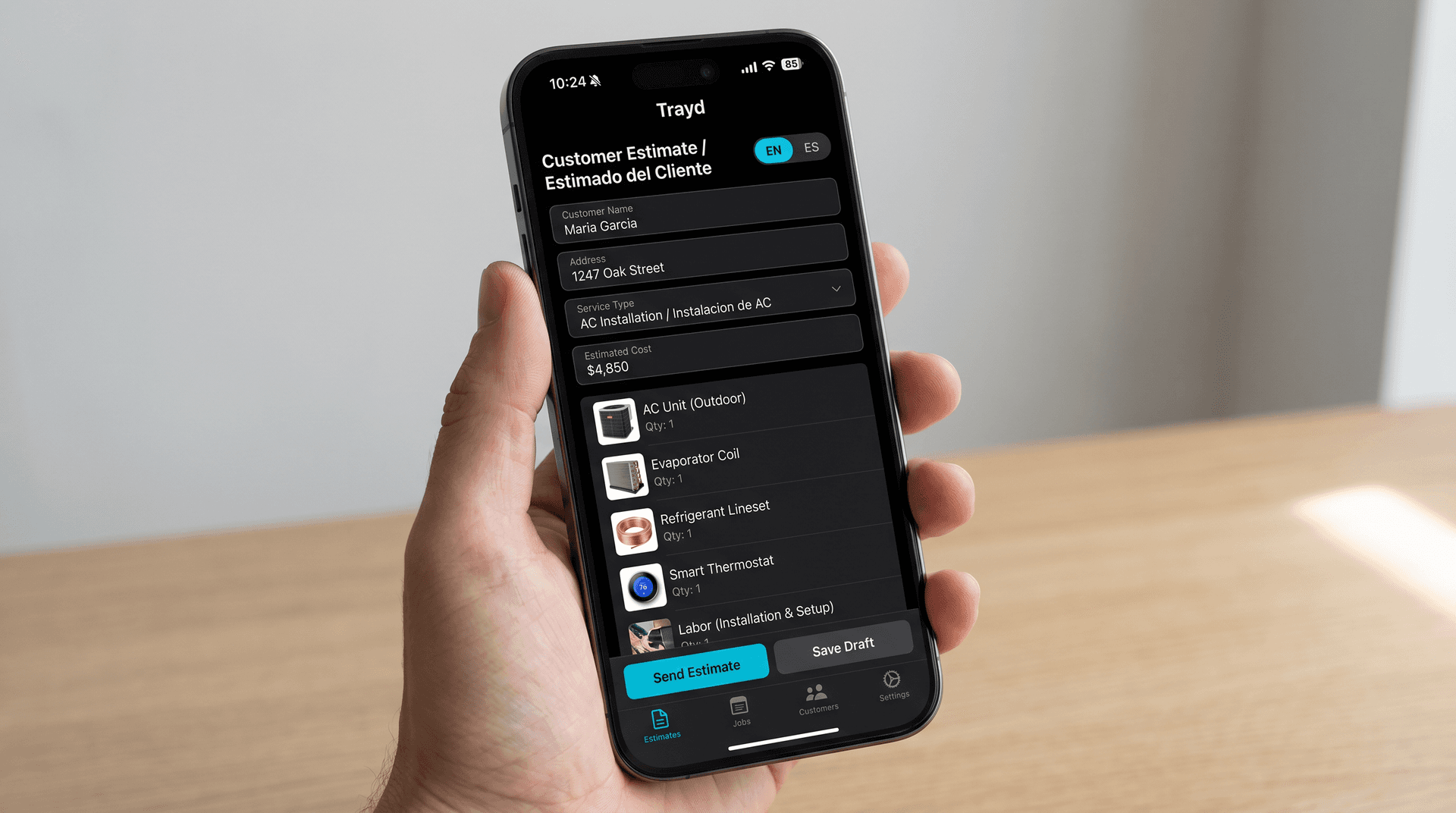
Dispatch board — 32 jobs today, 11 crews scheduled, regional load balanced live.
What it actually looks like.
Architecture diagrams, CI runs, and dashboards from the engagement.
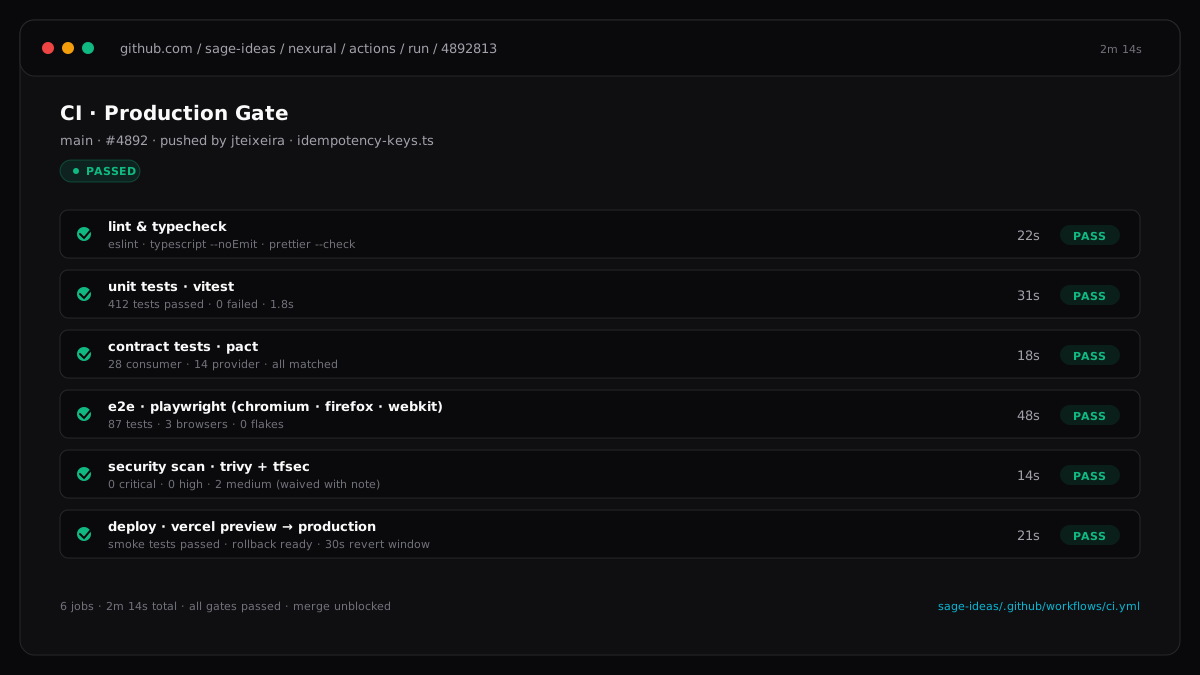
What shipped.
The verbatim ship record, given timeline structure.
- log · entry 01
Bilingual UI (EN/ES) — all copy, labels, AI responses, and notifications. AI diagnostic companion — natural-language symptom input, structured system guidance output. Estimate builder — field-input form → branded PDF → email delivery.
- log · entry 02
Callback scheduler — lightweight CRM for follow-up management. PWA with offline mode for core workflows. Beta deployment to initial Phoenix-area HVAC contractors.
What it proved.
Beta live with initial cohort of Phoenix-area HVAC contractors. 100% bilingual coverage from first public release — no "coming soon" for Spanish. Estimate-to-callback workflow tested and validated by actual contractors.
Zero external capital required to reach beta: fully bootstrapped.
Bilingual-from-scratch is an engineering discipline, not a translation afterthought. Building it into the architecture (prompt templates, UI copy management, locale routing) from day one is significantly less work than retrofitting it. Trayd validated that small trades businesses will adopt software if it matches their actual workflow.
Talk to people on this work.
No fabricated quotes. Reference contacts are shared during discovery, with both parties' consent.
Engineering lead
Worked alongside on production trading systems for 5+ years. Available for technical reference calls — code quality, on-call discipline, incident behavior.
Founder
Engaged Sage Ideas for a Ship + Operate combination. Willing to talk about scope discipline, timeline accuracy, and what handoff actually looked like.